 Merix.
Project at a glance
Resume-to-job matching, with the reasoning behind every match.
Swipe the section links to explore this project.
Overview & status
Current statusDemo paused
A resume-to-job-description matching application for recruiters, focused on making candidate matching easier to understand and review.
From the README
knowprasad/merix · README.md ↗Synced from the public repository
In this README 24 sections
Merix
Explainable, evidence-grounded resume matching — built for recruiters and campus placement teams






📋 Table of Contents
- About
- Features
- Live Demo
- Tech Stack
- Architecture
- Project Structure
- Getting Started
- Environment Variables
- Testing & Linting
- Deployment
- API Overview
- Roadmap
- Contributing
- License
🧠 About
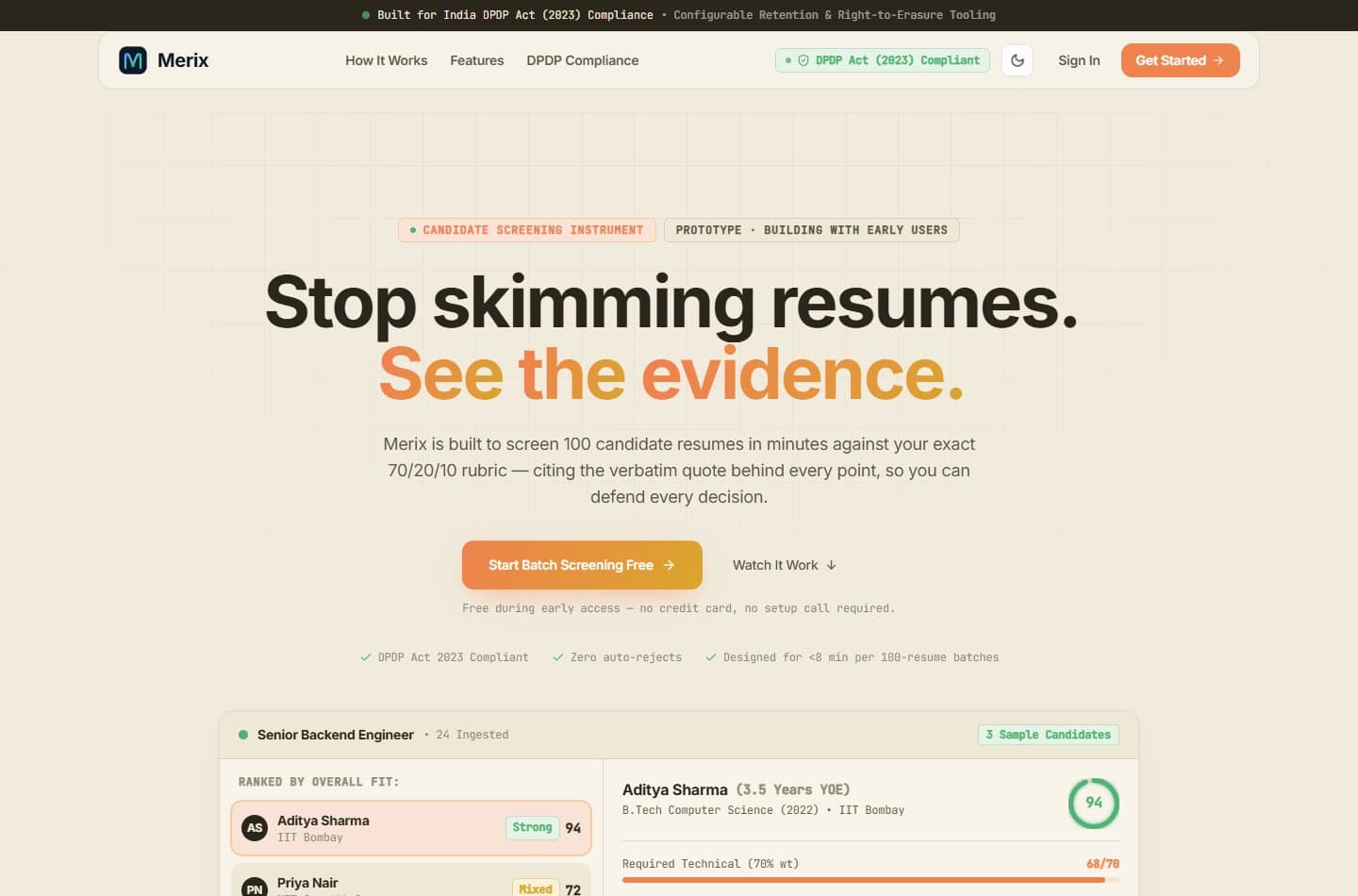
Merix is an AI-powered resume-to-job-description matching platform designed for modern recruiters and campus placement teams.
Unlike traditional ATS systems that act as "black boxes" — rewarding keyword-stuffing and rejecting strong candidates who use different terminology — Merix provides explainable, evidence-grounded match scores by carefully comparing candidates' actual skills against job requirements, with verbatim rationale extracted directly from each resume.
Built from day one to comply with India's Digital Personal Data Protection (DPDP) Act, Merix handles consent tracking, retention policies, PII scrubbing, and candidate right-to-erasure as first-class features.
✨ Features
| Feature | Description |
|---|---|
| Batch Matching | Upload one Job Description (JD) and up to 100 resumes (PDF) in a single batch. Receive an asynchronously ranked shortlist of candidates. |
| Explainable AI | Every match score shows exactly which skills matched (required vs preferred), which are missing, and verbatim evidence quoted directly from the candidate's resume. |
| Weighted Score Breakdown | Transparent 70/20/10 weighted scoring with per-candidate drill-down, score threshold filters (All / 80+ / 70+ / 60+), and CSV export. |
| DPDP Compliance | Explicit consent gates before upload, configurable retention policies with automatic sweepers, PII scrubbing before LLM calls, immutable audit logging, and candidate right-to-erasure endpoints. |
| Multi-Tenancy | Fully isolated organizations via PostgreSQL Row-Level Security (RLS) on Supabase. |
| Provider-Agnostic AI | Swappable LLM/embedding clients (Groq, OpenAI, Google Gemini) behind clean abstractions — no business logic changes required. |
| Real-Time Batch Status | Live progress polling with partial-failure breakdowns and itemized candidate streams during processing. |
| Production-Ready Backend | Async FastAPI server, layered architecture (routes → services → repositories → models), robust background task management, and rate limiting. |
🌐 Live Demo
The application is deployed and available at: https://merix-cyan.vercel.app
The frontend is hosted on Vercel and talks to the FastAPI backend deployed on Render.
⚠️ Note: The Render free tier spins the backend down after 15 minutes of inactivity. The first request may take 30–60 seconds while the instance cold-starts.
🛠 Tech Stack
Backend
- Framework: FastAPI (fully async), Python 3.11+
- Database: PostgreSQL + pgvector (Supabase)
- ORM / Migrations: SQLAlchemy 2.0 (async, NullPool) + Alembic
- AI Providers: Groq (LLM inference), Google Gemini (embeddings) — provider-agnostic client layer
- Document Parsing: PyMuPDF with strict input validation (size limits, magic bytes, corrupt/encrypted/scanned rejection)
- Auth: Supabase Auth (GoTrue) JWT verification
- Observability: structlog structured logging
Frontend
- Framework: Next.js 16 (App Router) + TypeScript + React 19
- Styling: Tailwind CSS ("Apple Liquid Glass" deep
#050505palette with frosted glass cards) - Animation: Framer Motion
- Charts: Recharts
- Icons: Lucide React
Infrastructure
- Hosting: Vercel (frontend) · Render (backend)
- Data Platform: Supabase (Postgres, Auth, Storage, RLS)
🏗 Architecture
Merix follows a clean layered architecture with strict separation of concerns:
┌─────────────────────┐        ┌──────────────────────────────────┐
│   Next.js Frontend  │  HTTP  │         FastAPI Backend          │
│   (Vercel, SPA)     │◄──────►│           (Render)               │
└─────────────────────┘        └──────────────┬───────────────────┘
                                              │
                     ┌────────────────────────┼─────────────────────┐
                     ▼                        ▼                     ▼
              ┌────────────┐          ┌──────────────┐      ┌──────────────┐
              │ Supabase   │          │ LLM Provider │      │  Embeddings  │
              │ Postgres + │          │ (Groq / etc.)│      │   (Gemini)   │
              │ pgvector + │          └──────────────┘      └──────────────┘
              │ Auth + RLS │
              └────────────┘
Request flow inside the backend:
Routes (api/v1) → Services (business logic) → Repositories (data access) → Models (SQLAlchemy)
                                        ↘ Clients (LLM / embeddings / storage abstractions)
Key architectural decisions:
- Layered architecture: routes → services → repositories → models, with external providers isolated behind client protocols.
- Async-first: async SQLAlchemy with NullPool, background task management for batch processing, idempotent and retry-safe batches.
- Privacy by design: PII is scrubbed before any text reaches an LLM provider.
- Cost-conscious LLM usage: caching, batching, and token tracking built into the pipeline.
📁 Project Structure
merix/
├── backend/                  # FastAPI backend application
│   ├── src/merix/
│   │   ├── api/              # Routes (versioned v1)
│   │   ├── core/             # Security, logging, exceptions
│   │   ├── models/           # SQLAlchemy models
│   │   ├── schemas/          # Pydantic schemas
│   │   ├── services/         # Business logic (extraction, matching, DPDP)
│   │   ├── repositories/     # Data access layer
│   │   └── clients/          # LLM / embedding / storage abstractions
│   ├── migrations/           # Alembic migrations
│   ├── tests/                # Pytest unit & integration tests
│   └── README.md             # Backend-specific setup guide
├── frontend/                 # Next.js 15 frontend application
├── docs/                     # Documentation assets
├── render.yaml               # Render Blueprint for backend deployment
├── PRD.md                    # Product requirements and v1 scope
├── CONTEXT.md                # Detailed project context and current state
├── AGENT.md                  # Conventions for AI-assisted development
├── CONTRIBUTING.md           # Contribution guidelines
└── CHANGELOG.md              # Per-task feature history
🚀 Getting Started
Prerequisites
- Python 3.11.10 (see
.python-version) - Node.js 22.14.0 and npm (see
.nvmrc) - uv — fast Python package manager
- A Supabase project (PostgreSQL + pgvector + Auth + Storage)
- API keys for an LLM provider (Groq) and an embeddings provider (Google Gemini)
Backend Setup
-
Clone the repository and enter the backend directory:
textgit clone https://github.com/prsdx/merix.git cd merix/backend -
Install dependencies:
textuv sync -
Configure environment variables:
textcp .env.example .env # Edit .env with your Supabase connection string and API keys -
Apply database migrations:
textuv run alembic upgrade head -
Start the development server:
textuv run uvicorn merix.main:app --reload --app-dir src -
Verify it's running:
- Interactive API docs: http://localhost:8000/docs
- Health check: http://localhost:8000/health
Frontend Setup
-
Enter the frontend directory and install dependencies:
textcd ../frontend npm install -
Configure the backend URL:
Create a
.env.localfile infrontend/pointing at your backend instance:textNEXT_PUBLIC_API_URL=http://localhost:8000 -
Start the development server:
textnpm run dev -
Open http://localhost:3000 in your browser.
🔐 Environment Variables
Backend configuration lives in backend/.env (see backend/.env.example):
| Variable | Description |
|---|---|
DATABASE_URL | PostgreSQL connection string (postgresql+asyncpg://...) — Supabase Postgres + pgvector |
LLM_PROVIDER / LLM_MODEL / LLM_API_KEY | LLM provider config (e.g., Groq, openai/gpt-oss-120b) |
EMBEDDING_PROVIDER / EMBEDDING_MODEL / EMBEDDING_API_KEY | Embeddings provider config (e.g., Google, gemini-embedding-001) |
STORAGE_PROVIDER / STORAGE_BUCKET | Resume file storage (Supabase Storage) |
SUPABASE_URL / SUPABASE_SERVICE_KEY | Supabase project URL and service key |
SUPABASE_JWT_SECRET | Secret used to verify Supabase GoTrue JWTs locally |
ADMIN_API_TOKEN | Shared token (via X-Admin-Token) required to trigger the retention sweep in production. Leave empty in development. |
ALLOWED_ORIGINS | Comma-separated CORS allowlist. Use "*" only in development. |
Frontend configuration lives in frontend/.env.local:
| Variable | Description |
|---|---|
NEXT_PUBLIC_API_URL | Base URL of the Merix backend API |
🔒 Security note: Retention is configured per organization (default 90 days) via
PATCH /api/orgs/me. All PII is scrubbed before being sent to any LLM provider.
🧪 Testing & Linting
Run the offline unit-test gate from the repository root:
make test
The integration suite needs PostgreSQL + pgvector; CI provisions an ephemeral
container for it and runs it on pushes to main and nightly. Run it locally
with cd backend && uv run pytest tests/integration -v when a test database is
available.
Lint and format with Ruff:
make lint
make frontend-lint
The CI pipeline runs lint, unit tests, and migration-drift checks on every
push/PR. The containerized integration suite runs on main and nightly.
☁️ Deployment
Backend (Render)
The backend deploys to Render via the included render.yaml Blueprint:
- Connect this repository to your Render account.
- Select New Blueprint and let Render sync the configuration.
- Provide values for secure environment variables marked
sync: false:DATABASE_URL,SUPABASE_URL,SUPABASE_SERVICE_KEY,SUPABASE_JWT_SECRETLLM_API_KEY,EMBEDDING_API_KEY,ALLOWED_ORIGINS
- Render builds (
pip install uv && uv sync --frozen) and runs migrations before starting the service. - Verify with a
GET /healthrequest.
⚠️ On Render's free tier, the service sleeps after 15 minutes of inactivity (~30–60s cold start). Warm it up with a health-check ping before demos.
Frontend (Vercel)
The frontend is deployed on Vercel at https://merix-cyan.vercel.app:
- Import the repository into Vercel and set the root directory to
frontend/. - Set
NEXT_PUBLIC_API_URLto the live Render backend URL. - Add the Vercel domain to the backend's
ALLOWED_ORIGINS.
🔌 API Overview
Application endpoints are mounted under /api (the module layout remains
api/v1). Full interactive docs are served at /docs (Swagger UI).
| Area | Endpoint | Purpose |
|---|---|---|
| Health | GET /health | Service liveness probe |
| Jobs | POST /api/jobs | Create JD with semantic extraction preview |
| Jobs | GET /api/jobs | List org jobs with resume/match counts |
| Resumes | POST /api/jobs/{id}/resumes | Batch PDF upload (behind DPDP consent gate) |
| Batch | GET /api/batch-jobs/{id} | Poll batch processing status/progress |
| Matching | GET /api/jobs/{id}/matches/export | Export ranked shortlist as CSV |
| Candidates | DELETE /api/candidates/{id} | DPDP right-to-erasure hard delete |
| Orgs | GET/PATCH /api/orgs/me | Org profile + DPDP retention policy |
| Audit | GET /api/orgs/audit-logs | Immutable compliance audit log |
| Admin | POST /api/admin/retention-sweep | Trigger retention sweeper (X-Admin-Token) |
🗺 Roadmap
- ☑ Core matching pipeline (extraction → embedding → scoring → explanation)
- ☑ Auth, organizations, and multi-tenancy (Supabase RLS)
- ☑ DPDP consent gate, retention policy, audit log, erasure
- ☑ Security hardening (input validation, rate limiting, JWT verification)
- ☑ Production frontend (9 core screens, end-to-end integration)
- ☑ Vercel deployment (live demo)
- ☐ Match-score calibration evaluation set
- ☐ Multi-tenant billing/subscriptions (v2)
- ☐ Candidate self-service portal (v2)
- ☐ External ATS integrations (v2+)
See PRD.md for the complete product scope and CHANGELOG.md for per-task history.
🤝 Contributing
Contributions are welcome! Please see CONTRIBUTING.md for guidelines on code style (Ruff), Conventional Commits, branch naming, and the CI/CD pipeline.
📄 License
This project is licensed under the MIT License — see the LICENSE file for details.
Screens & walkthrough
Limitations & links
The demo backend is currently paused.